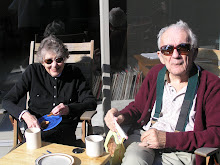
The other day, I discovered the Bladder Cancer Web Cafe. It's an open forum where people discuss their bladder cancer -- their treatment options and experiences -- their doctors' attitudes, etc. But most of all it's a place for support, encouragement and hope.
The members really helped me prepare for my father's appointment with his urologist. It's always a good idea to be armed with as much knowledge as possible.
As it turned out, we didn't have the "battle" with the doctor as I had expected. We quietly mentioned that my Dad did not want to have the BCG treatments again. That, at 83, he didn't want to spend the next three years of his life feeling terrible all of the time. And at the end of the three-year treatment plan? What is there on the other side? Realistically, the next three years may be the rest of his life. He'd much rather feel good most of the time and still try to enjoy what life he has.
Showing posts with label elderly parents. Show all posts
Showing posts with label elderly parents. Show all posts
Tuesday, August 7, 2007


Wednesday, August 1, 2007
It's Overwhelming
I am in the shower, with the hot water hitting me and feeling pretty good ... and I pick up the shampoo bottle and squeeze some out and suddenly I find myself crying. I rub the shampoo into my hair and I'm still crying.
Later, I'm doing the dishes and the tears start up again. I just can't stop. I'll be fine one minute and the next, say, I'm in the grocery store picking up a can of tomatoes and guess what? I'm crying again.
I've never before felt so close to life and death at the same time.
My Dad was diagnosed with bladder cancer (although his urologist didn't bother to tell him that) back in November of 2004. He didn't really find out that's what was wrong until he and my Mom moved here in 2005 and he saw a new urologist. Copying his records, I saw the words: Diagnosis: Superficial Bladder Cancer.
Since then, he's been having TURBs done about every six months to remove new growths. Now, the urologist wants to start something called maintenance BCG ... where the live turberculosis bacteria is put into the bladder to stimulate your own immune system ... which somehow seems to help retard the growth of new tumors.
The only problem is, the treatment ... 6 initial weekly visits, then three weeks more three months later, etc., continually for three years ... involves the person feeling tired, getting flu-like symptoms, etc. My Dad is 83 ... going to be 84 in November, please God.
What sort of a life would that be?
None of us knows how much time we have, but I feel my Dad's time very keenly.
Later, I'm doing the dishes and the tears start up again. I just can't stop. I'll be fine one minute and the next, say, I'm in the grocery store picking up a can of tomatoes and guess what? I'm crying again.
I've never before felt so close to life and death at the same time.
My Dad was diagnosed with bladder cancer (although his urologist didn't bother to tell him that) back in November of 2004. He didn't really find out that's what was wrong until he and my Mom moved here in 2005 and he saw a new urologist. Copying his records, I saw the words: Diagnosis: Superficial Bladder Cancer.
Since then, he's been having TURBs done about every six months to remove new growths. Now, the urologist wants to start something called maintenance BCG ... where the live turberculosis bacteria is put into the bladder to stimulate your own immune system ... which somehow seems to help retard the growth of new tumors.
The only problem is, the treatment ... 6 initial weekly visits, then three weeks more three months later, etc., continually for three years ... involves the person feeling tired, getting flu-like symptoms, etc. My Dad is 83 ... going to be 84 in November, please God.
What sort of a life would that be?
None of us knows how much time we have, but I feel my Dad's time very keenly.
Sunday, July 29, 2007
Maybe It's Not Alzheimer's Disease
Many elderly people who show any signs of confusion are quickly stamped "Alzheimer's Patient." However, simply because your parent shows signs of forgetfulness or dementia you mustn't necessarily assume he has Alzheimer's.
There are so many other conditions that may be contributing to odd behavior ... including urinary-tract infections!
One thing to keep in mind: Elderly people metabolize drugs much differently from younger people.
If your parent is acting oddly, first check the medicine cabinet. Is he or she taking any kind of sleeping pill? Anti-anxiety pill? Anti-depressant? These can often be the culprit of confusion, vivid dreams and/or hallucinations. Exactly what are the prescriptions your parent's doctor has offered? Be pro-active. Do a thorough research (the internet is a great source) of all the possible side effects of every prescription. Many of the prescriptions my mother first received were definitely NOT for the elderly. Now, I make it habit of researching the medicines before filling the prescriptions. If we come upon something that says, "Not for use in the elderly." or "Not effective in persons over 65" or anything else such as this, we don't fill them and we have a talk with the doctor.
If you find your parent's doctor continually prescribing things that are not appropriate, consider finding a geriatric specialist. You wouldn't think of bringing your baby to an internist ... you'd find a pediatrician who has studied extensively effects of medicines and diseases and disorders in children ... so why bring your elderly parent to an internist? A geriatric specialist has studied the aging body and should be more aware of how your parent is suffering ... and when prescribing drugs, the geriatric specialist should be more aware of what is suitable and what isn't.
If pills are not the problem, have you ever had your parent's blood checked for the hereditary condition called Pernicious Anemia? This disease does not allow the body to absorb Vitamin B12 and, while the cure is easy enough, it presents a myriad of symptoms, including very definite behavior changes, even hallucinations.
Again, if this turns out negative, be sure to check the thyroid, too. An overactive thyroid can be just as much a cause of strange behavior as anything else.
Be sure to check the physical aspects first ... through brain scans, blood and urine tests, etc. Please don't simply assume it's Alzheimer's.
There are many other causes of delusions/hallucinations in the elderly, as well ... for instance, one is called "paraphrenia" -- which is thought to be a late-onset form of schizophrenia experienced by the elderly who are isolated and lonely. The cure can be as simple as getting out and doing things, meeting people and taking part in specially-designed exercise classes for the elderly. If your parent's doctor prescribes anti-psychotic medicines, do a little research on their side effects and monitor your parent's behavior. Sometimes the side effects are worse than the disease! Check your local YMCA for arthritis water aerobic classes, chair exercises, stretching, etc. Exercise and socialization are often the keys to wellness.
There are so many other conditions that may be contributing to odd behavior ... including urinary-tract infections!
One thing to keep in mind: Elderly people metabolize drugs much differently from younger people.
If your parent is acting oddly, first check the medicine cabinet. Is he or she taking any kind of sleeping pill? Anti-anxiety pill? Anti-depressant? These can often be the culprit of confusion, vivid dreams and/or hallucinations. Exactly what are the prescriptions your parent's doctor has offered? Be pro-active. Do a thorough research (the internet is a great source) of all the possible side effects of every prescription. Many of the prescriptions my mother first received were definitely NOT for the elderly. Now, I make it habit of researching the medicines before filling the prescriptions. If we come upon something that says, "Not for use in the elderly." or "Not effective in persons over 65" or anything else such as this, we don't fill them and we have a talk with the doctor.
If you find your parent's doctor continually prescribing things that are not appropriate, consider finding a geriatric specialist. You wouldn't think of bringing your baby to an internist ... you'd find a pediatrician who has studied extensively effects of medicines and diseases and disorders in children ... so why bring your elderly parent to an internist? A geriatric specialist has studied the aging body and should be more aware of how your parent is suffering ... and when prescribing drugs, the geriatric specialist should be more aware of what is suitable and what isn't.
If pills are not the problem, have you ever had your parent's blood checked for the hereditary condition called Pernicious Anemia? This disease does not allow the body to absorb Vitamin B12 and, while the cure is easy enough, it presents a myriad of symptoms, including very definite behavior changes, even hallucinations.
Again, if this turns out negative, be sure to check the thyroid, too. An overactive thyroid can be just as much a cause of strange behavior as anything else.
Be sure to check the physical aspects first ... through brain scans, blood and urine tests, etc. Please don't simply assume it's Alzheimer's.
There are many other causes of delusions/hallucinations in the elderly, as well ... for instance, one is called "paraphrenia" -- which is thought to be a late-onset form of schizophrenia experienced by the elderly who are isolated and lonely. The cure can be as simple as getting out and doing things, meeting people and taking part in specially-designed exercise classes for the elderly. If your parent's doctor prescribes anti-psychotic medicines, do a little research on their side effects and monitor your parent's behavior. Sometimes the side effects are worse than the disease! Check your local YMCA for arthritis water aerobic classes, chair exercises, stretching, etc. Exercise and socialization are often the keys to wellness.
Saturday, July 28, 2007
Why I'm Starting This Blog ...
When my parents, both in their 80s, moved from California to North Carolina to be closer to me, I had no idea what was in store for them.
A move, for anyone, can be traumatic, but for my parents, it seemed particularly so. I hadn't thought about the move, itself, presenting such hardships ... especially for my parents who had moved often through their married life together. I thought it would be a piece of cake ... a walk in the park. Instead, it was a nightmare.
In trying to find solutions to many of their problems, both psychological and physical, I've had to spend lots of hours doing research. I'm hoping that some of the research I've done might be beneficial to others who find themselves in the same place I am.
A move, for anyone, can be traumatic, but for my parents, it seemed particularly so. I hadn't thought about the move, itself, presenting such hardships ... especially for my parents who had moved often through their married life together. I thought it would be a piece of cake ... a walk in the park. Instead, it was a nightmare.
In trying to find solutions to many of their problems, both psychological and physical, I've had to spend lots of hours doing research. I'm hoping that some of the research I've done might be beneficial to others who find themselves in the same place I am.
Subscribe to:
Posts (Atom)